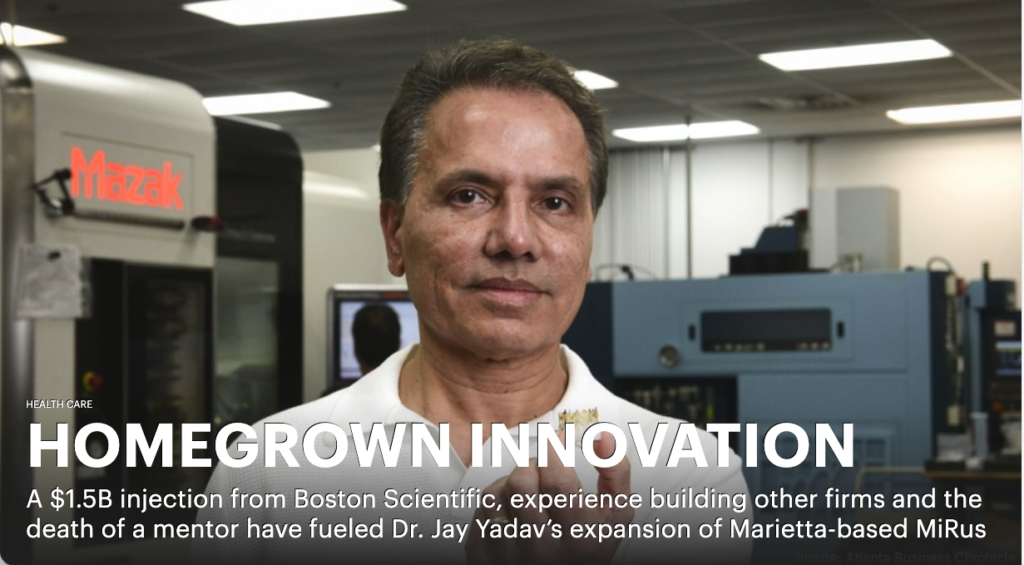
Atlanta Business Chronicle Aug 12, 2026 by Gabriela Henriquez Stoikow – Contributing Writer — When Dr. Jay Yadav was working as an interventional cardiologist at the Cleveland Clinic more than 20 years ago, he kept running into the same question: Could there be a better material for treating severe aortic stenosis?
After speaking with multiple colleagues as well as the late industrialist Saul Siegel, Yadav began to experiment with the chemical element rhenium, which NASA had used in rocket nozzles as far back as the 1970s. The material was very strong and hard but also very flexible, which was unusual, he said. That’s what motivated Yadav to spend nearly two decades looking into the material and ultimately developing medical devices with it.
Yadav founds MiRus, develops devices using proprietary material
In 2016, Yadav founded MiRus LLC, a privately held company headquartered in Marietta whose name is based on the Latin root for “miraculous.” In 2019, the company received Food and Drug Administration 510(k) clearances for spinal surgery innovations and has since developed several orthopedic and spinal devices using MoRe Superalloy, a proprietary molybdenum-rhenium material developed by MiRus.
Those products include the EUROPA Posterior Cervical System for treatment of the cervical and upper thoracic spine, which in 2024 received FDA Breakthrough Device Designation; the IO Expandable Wedge Osteotomy System, used in foot and ankle surgeries; the CYGNUS Anterior Cervical Plate System, a spinal implant used in neck fusion surgeries; and the GALILEO Spine Alignment Monitoring System, a wireless and real-time measurement system for sagittal spine alignment during surgery.
This year, MiRus started conducting the STAR Trial to evaluate the safety and effectiveness of the Siegel transcatheter aortic valve replacement (TAVR) in patients with severe, symptomatic aortic stenosis. The heart valve — named in honor of Siegel, a friend and mentor to Yadav who died in 2009 from complications following an aortic valve replacement — is made with the nickel-free MoRe superalloy to include the unique properties of high-yield strength, fatigue resistance and minimal recoil.

GABRIELA HENRIQUEZ STOIKOW
Boston Scientific makes large investment
In May, MiRus received a $1.5 billion investment from Boston Scientific Corp. in exchange for an approximately 34% equity stake and an exclusive option to acquire the company’s TAVR system, if it completes certain clinical and regulatory milestones.
“The TAVR market is a very critical market; it’s very large, growing very healthy, and it’s a space that we need to be in,” Lance Bates, executive vice president and president of interventional cardiology and vascular therapies at Boston Scientific, told Atlanta Business Chronicle.
In the past, Boston Scientific has made investments in other TAVR technologies but ultimately discontinued them in favor of pursuing MiRus. “We believe it’s the best technology,” Bates said.
The investment will help fund the ongoing clinical trial, the continuing vertical integration of the company and an infrastructure expansion so it can create an inventory of about 60,000 valves in preparation for FDA approval, Yadav said.
Atlanta’s growth as a business-friendly city and as a medical research and development hub played a role in Boston Scientific’s decision to invest in MiRus. So did Yadav’s track record as a successful inventor and entrepreneur.
“We have high trust in his capabilities to invent, develop and bring to market unique technologies,” Bates said.


Yadav draws on past entrepreneurial successes
Yadav previously founded other companies, including CardioMEMS, acquired by St. Jude Medical (now Abbott) in 2014, and AngioGuard Inc., which is now owned by Johnson & Johnson.
“For me, it’s always about the patient and the problem. What is the problem? Is there a problem that’s not been solved? Is there a better solution? Can we get that better solution out?” Yadav said.
A few things have helped him along the way when creating successful businesses:
- Passion: A business should be a passion for something you really care about. “You better be passionate about it. You better really care about it. It should never be for money. If money is your motivation, you will not be successful,” he said.
- Improvement: Have some level of dissatisfaction with how things are currently being done and try to think about how you could improve it.
- Self-criticism: “Is there a real problem that the world thinks is a real problem? Do I have a better solution?,” he said. “I think this requires some level of self-awareness and criticality.”
After covering those bases, entrepreneurs should think about whether a reimbursement system works and how they will get paid for that product. Also, they should understand the regulatory framework because that will impact the business plan and how much money to raise.
Finally, Yadav thinks that if you’ve really solved a real problem, you won’t have any issues raising money.
“If the product is just flat-out better, the business is really simple,” he said.
Editor’s note: This story is part of Atlanta Business Chronicle’s “Advancing Health & Life Sciences in Georgia” special section, which will publish in the Aug. 14 print edition. An event featuring a fireside chat with MiRus CEO Dr. Jay Yadav and panel discussions on the future of Atlanta’s life sciences sector and the evolution of healthcare real estate will be held Aug. 13. To purchase tickets, visit the Chronicle’s events website.
SOURCE Atlanta Business Chronicle